
There is no millennial headquarters
Apologies to the beta carotines, you don’t exist
I feel like writing again. Sometimes there will be microprinciples. Today it’s a letter to the collective internet, whom I affectionately call “George.”
Dear George,
How is it that seemingly intelligent people still use generational labels? Generational labels mean nothing.
As far as I can tell, there is no such person as a Boomer, X-er, Millennial, Zoomer, or Alphabet. There are individuals and the generations they belong to. Yes, I remember the spike in births after WWII called the baby boom. Yes, those babies (eventually) had babies, and their children did too. But that’s all a generation is. A baby wave. 👋 👶
For some reason, you keep using it as a personality marker, like Myers-Briggs or Enneagram or Hogwarts. At my last job, some mojambo product designer kept referring to things as “millennial-coded” even though said mojambo would (probably) never apply that same judgment according to a person’s race, religion, gender, or nationality (“Seems like something a Zoroastrian would say…”). Yet there they were, casually asserting that every human born within a 22-year window sounds, acts, and behaves a certain way.
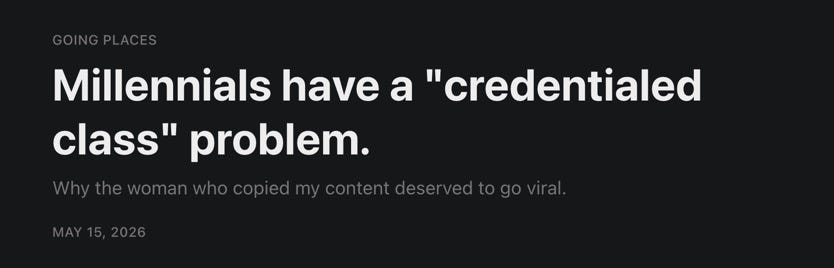
I don’t know, man. Generational labels are dumber than astrology, and even astrology has the restraint to only pigeonhole people into a measly month. Generational labels gulp decades into pithy proclamations: “Only people born between 1982 to 1999 could possibly understand the power of Sour Patch Kids.” It’s not true. Everyone understands Sour Patch Kids.
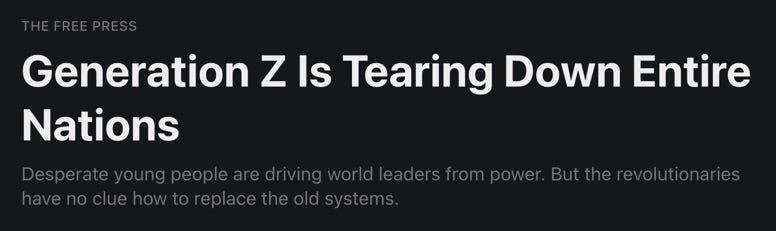
There is no “millennial urge.” There is no “Gen Z stare.” There is no “boomer cha cha.” There is no “Gen Alpha death grip.” There is no archetype that binds a billion babies. These generational labels exist largely to sell us consumer durables and corn products. Why are you so obsessed with them?
“Gen Z is strange.” No, they’re not. They’re just YOU born later, into a different world. “Boomers are strange.” No, they’re not. They’re how YOU would be if you were born sooner and spent most of your life without the palliative glow of the internet.
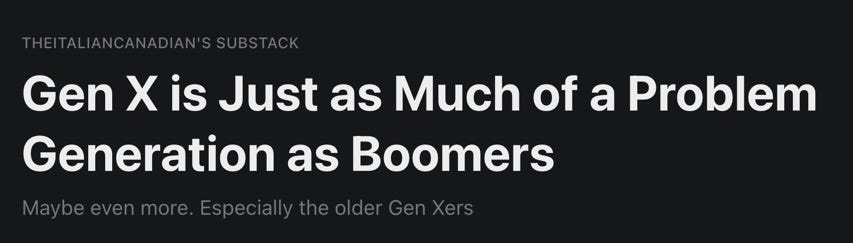
Swap in any other group when you see a generational label in print, and the writer sounds deranged:
[British-Italian migrants] like to call themselves the “toughest generation,” but whenever you criticize them for something, they throw huge temper tantrums online or go into denial mode
Why is the older half of [single Black mothers] so obsessed with infantilizing itself
[Asians with cystic fibrosis] aren’t too dumb to read the classics, and here’s why
Ironically, these swapped-in examples might have relevant characteristics that let you talk about them as a group—because they are smaller—but you should apply some discernment when doing so. Generational labels blithely make excruciatingly specific claims about billions of people all across the world, and for some reason George, you can’t get enough.
There is no millennial headquarters. There is no manual on how to be a boomer. There is no right way to be Gen Z. Generational labels aren’t a political party. They aren’t even a social construct. They’re a date range and even the dates are debatable. They are tool for demographers, not culture critics. All these takes do is assert that some generation is the problem and the problem cannot be Other People.

You keep using them like it explains anything. Yes, people born around the same time who lived through the same cultural phenomena are likely to have some shared vocabulary about their lived experience. So talk about the experience, not the person.
A generational label is not a personality.
A generational label is not a personality.
A generational label is not a personality.
As if we needed another reason to separate ourselves. George, we have real problems in this world and instead of fixing these problems you keep slicing the world into low-poly categories, then slap a value on that label (good/bad, yaasss/neighhhh, chummy/cheugy), and then barf honestly not-even-that-interesting takes about it all.
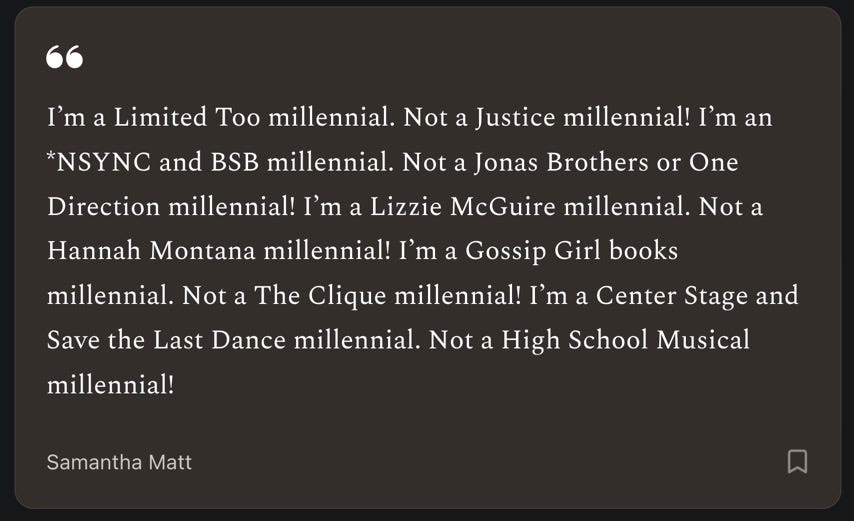
To solve the problems of the world, it will take all kinds: youngs, barely-legal, middle, olds, and dying. People of different kinds all have wisdom. This radical idea is called diversity. Diversity was never about labeling every plant in the forest and working out the sacred ratios for a perfect ecosystem. No one has the authority to do that. The only thing you can do is make the circle bigger and listen.
The gap between generations is not a problem to solve. There already exists a structure designed to help bridge the gulf. It’s called family. Just about everyone has parents, those kind-of-annoying older folks who know better than you (for a while) and never stop telling you what to do. Some people will make children too: the little folks you coddle and teach while avoiding the thought that, if you do your job well, you create people so advanced it may produce an impassable gulf of understanding between you.
And that’s what you want. You’re not meant to understand each other. You’re just meant to love each other. You don’t need to figure out the olds or the youngs. You just need to accept them. Enough with the generational labels. They don’t mean a thing.
Love,
V
“The only thing you can do is make the circle bigger and listen.” 💜